
Blog Details
- Member
- March 10, 2026
Indo Russian Joint Venture Opportunities in the Telecommunications Sector
Introduction
Telecommunications has emerged as
one of the most promising areas for industrial collaboration between India and
Russia. Both countries are undergoing significant transformations in their
digital infrastructure ecosystems, driven by rising demand for connectivity,
rapid technological evolution, and the need to diversify supply chains for
telecommunications equipment and services.
India represents one of the world’s
fastest-growing telecommunications markets, with nearly one billion broadband
users and expanding digital services across urban and rural regions. Despite
this scale, large geographic areas remain underserved, creating strong demand
for new technologies such as satellite communications, fixed wireless access,
and advanced wireless infrastructure.
Russia, meanwhile, faces an urgent
need to develop new telecommunications supply chains and technologies. The
Russian telecom sector is restructuring its equipment ecosystem and requires
substantial deployment of new infrastructure including 4G and 5G base stations.
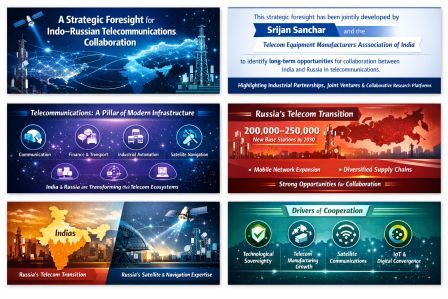
Estimates suggest that Russia may require between 200,000 and 250,000 base
stations by 2030, creating a significant opportunity for partnerships with
international technology providers.
These complementary needs create a
strong foundation for Indo-Russian joint ventures in telecommunications. India
can provide large-scale manufacturing and engineering capabilities for telecom
equipment, while Russia offers expertise in satellite navigation systems,
applied geolocation technologies, and integrated telematics platforms.
The convergence of
telecommunications, satellite communications, navigation systems, and digital
services provides a broad platform for joint industrial projects between
companies from both countries.
Strategic Drivers for Indo-Russian Telecom Cooperation
The telecommunications partnership
between India and Russia is driven by several structural trends.
First, both countries are seeking
technological sovereignty and diversification of supply chains in critical
digital infrastructure. Russia is actively searching for alternatives to
traditional equipment suppliers and is exploring collaboration with Indian
telecom vendors as part of this strategy.
Second, India has rapidly expanded
its telecom manufacturing capabilities under industrial initiatives that
encourage local production of telecom equipment and digital technologies.
Government programs have stimulated investment and created a large engineering
base capable of producing telecom hardware and network systems.
Third, satellite communications are
becoming an important complement to terrestrial networks in both countries.
Satellite systems are increasingly used to provide connectivity in remote
regions where fiber or mobile networks are difficult to deploy.
Fourth, the integration of
navigation technologies such as Russia’s GLONASS system and India’s NavIC
system is opening new possibilities in logistics, transport safety, and telematics
services.
These technological trends create a
strong basis for industrial collaboration through joint ventures.
Constraints Affecting Indo-Russian Telecom Joint
Ventures
Despite strong opportunities,
several structural challenges must be addressed for telecommunications
partnerships to succeed.
One constraint is the regulatory
complexity surrounding satellite communications and spectrum allocation.
Regulatory frameworks in both countries are evolving, and satellite-based
telecom services require careful coordination between operators and government
agencies.
Another constraint relates to
localization requirements. Russia is encouraging the use of domestically
produced telecommunications equipment in public networks, meaning that foreign
companies must participate through localized manufacturing or joint product
development rather than simple export.
Technology supply chains also remain
a challenge. The telecommunications sector relies on advanced semiconductor
components and network technologies, requiring careful coordination of
manufacturing capabilities and supply logistics.
Finally, cross-border financing and
payment mechanisms can create operational challenges for technology
partnerships. However, financial institutions are developing faster settlement
systems and new trade finance mechanisms that facilitate business cooperation
between Indian and Russian companies.
Fifteen Indo-Russian Telecommunications Joint Venture
Opportunities
1
5G Base Station Manufacturing
An important joint venture opportunity
lies in manufacturing 4G and 5G base stations for the Russian market. Russian
telecom operators require large-scale deployment of base stations to modernize
their networks and expand LTE and 5G coverage.
Indian telecom equipment
manufacturers could establish localized manufacturing facilities in Russia to
produce radio access network equipment.
Possible partners could include
Indian telecom equipment firms and Russian network operators.
2
Open RAN Network Development
The development of Open RAN
architecture represents another promising area of collaboration. Open RAN
allows telecom operators to deploy modular network equipment using standardized
interfaces.
Indian companies developing Open RAN
solutions could collaborate with Russian telecom operators to deploy
cost-efficient and flexible mobile networks.
3
Satellite Internet Services
Satellite-based broadband services
are emerging as a major growth segment in the telecommunications sector.
Satellite internet can provide connectivity in remote regions where traditional
telecom infrastructure is limited.
Joint ventures could focus on
developing satellite broadband platforms combining Indian ground infrastructure
and Russian satellite technologies.
4
Telecom Equipment Manufacturing
India’s telecom manufacturing
ecosystem can support joint production of routers, switches, and wireless
network equipment for Russian telecom networks.
Local manufacturing facilities could
supply equipment not only to Russia but also to other Eurasian markets.
5
GLONASS–NavIC Navigation Integration
Russia’s GLONASS navigation system
and India’s NavIC regional navigation system could be integrated to develop
high-precision positioning services.
Joint ventures could develop
navigation solutions for transport, logistics, and smart city applications.
6
Telematics and Fleet Management Systems
Russia already operates large
vehicle monitoring systems connected to the ERA-GLONASS emergency response
network.
Joint ventures could develop
telematics platforms combining navigation technology with telecommunications
networks to support logistics companies and public transport systems.
7
Rural Connectivity Platforms
Satellite and wireless technologies
can be combined to provide affordable connectivity in rural regions.
Joint ventures could develop
integrated solutions combining satellite communication with fixed wireless
networks.
8
Data Center Infrastructure
The rapid growth of digital services
requires the development of data center infrastructure.
Indo-Russian joint ventures could
establish regional data centers supporting telecom networks, cloud computing
services, and digital platforms.
9
Internet of Things (IoT) Platforms
The expansion of IoT devices across
industries such as transportation, manufacturing, and energy creates
opportunities for telecom infrastructure development.
Joint ventures could build IoT
connectivity platforms serving industrial and smart city applications.
10
Cybersecurity for Telecom Networks
Telecommunications infrastructure
requires strong cybersecurity systems to protect networks from digital threats.
Joint ventures could develop
cybersecurity solutions specifically designed for telecom networks and digital
infrastructure.
11
Smart City Communication Systems
Telecommunications infrastructure
forms the backbone of smart city technologies including traffic management,
surveillance systems, and urban connectivity.
Indo-Russian partnerships could
develop communication systems for smart city infrastructure.
12
Telecom Software Platforms
Software defined networking and
telecom management platforms represent an important part of modern telecom
infrastructure.
Joint ventures could develop network
management software for telecom operators.
13
Satellite Ground Station Infrastructure
The integration of satellite
communications requires ground station infrastructure for monitoring and
controlling satellite networks.
Joint ventures could develop ground
stations supporting satellite communication services in both countries.
14
Telecom Training and Skill Development Centers
The telecommunications industry
requires highly skilled engineers and technicians.
Joint ventures could establish
training centers focused on telecom engineering, network deployment, and
digital infrastructure.
15
Telecom Financial Technology Platforms
Digital payment and telecom service
integration is another emerging area.
Joint ventures could develop
platforms enabling telecom operators to provide digital financial services to
customers.
Role of Srijan Sanchar
Srijan Sanchar can play a catalytic
role in facilitating Indo-Russian telecommunications joint ventures. The
organization can function as a neutral platform that connects telecom
companies, technology developers, financial institutions, and policymakers from
both countries.
One of its key roles could be to
identify complementary technological capabilities and organize structured
dialogues between companies exploring joint ventures. By preparing feasibility
studies and sectoral research reports, Srijan Sanchar can help companies
understand market opportunities and regulatory frameworks in both countries.
Srijan Sanchar can also organize
industry forums and technology dialogues where telecom companies from India and
Russia can explore partnerships in areas such as satellite communications,
navigation systems, and digital infrastructure.
In addition, the organization can
work with financial institutions and government agencies to address operational
challenges related to financing, cross-border payments, and regulatory
coordination.
Strategic Impact
The development of Indo-Russian
telecommunications joint ventures could significantly strengthen the
technological partnership between the two countries. Such collaborations would
support the modernization of telecom infrastructure in Russia while expanding
the global reach of India’s telecom manufacturing ecosystem.
Over time, these joint ventures
could evolve into a broader Eurasian digital infrastructure network connecting
telecommunications, satellite systems, navigation technologies, and digital
services.
This partnership has the potential
not only to expand bilateral trade but also to create new technology platforms
that serve markets across Asia, Europe, and the Global South.